
· Insights · 2 min read
Why Understanding Deep Tech Requires More Than Market Analysis
Traditional market analysis often fails to capture the true potential of deep technologies. Understanding scientific maturity, technical uncertainty and ecosystem dynamics is essential for making informed strategic decisions.
Why Understanding Deep Tech Requires More Than Market Analysis
Most technology assessments begin with market reports, competitor analyses, and industry forecasts. While these tools are useful, they often provide only a partial picture when it comes to deep technologies.
Unlike conventional software or consumer products, deep technologies emerge from years of scientific research. Their trajectory depends not only on market demand, but also on scientific breakthroughs, engineering challenges, intellectual property, regulatory developments, and the maturity of the surrounding ecosystem.
For organizations making strategic decisions, relying solely on market indicators can therefore lead to incomplete, or even misleading, conclusions.
Deep technologies follow different dynamics
Technologies such as quantum computing, advanced photonics, synthetic biology, or new semiconductor architectures evolve according to scientific progress rather than traditional product cycles.
A promising laboratory result does not immediately become a commercial opportunity. Between discovery and industrial adoption lie years of engineering, validation, manufacturing, and ecosystem development.
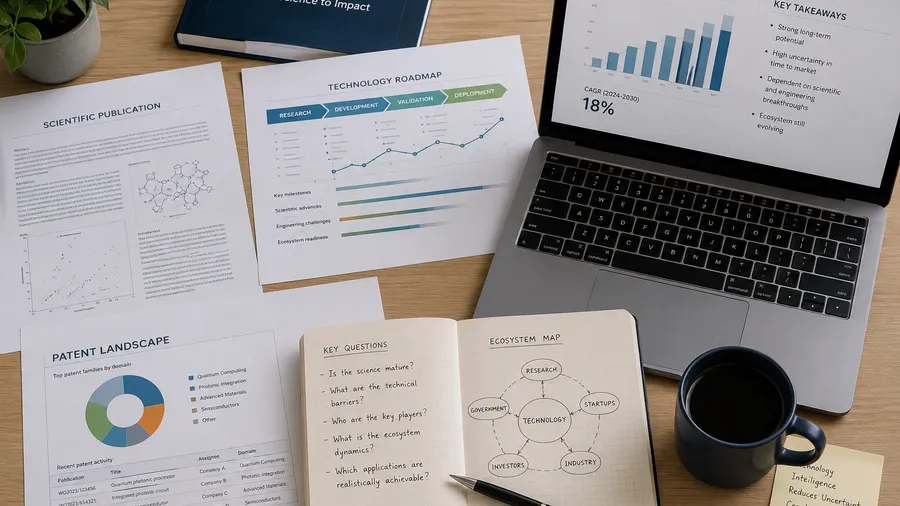
Understanding where a technology truly stands requires reading scientific publications, patents, startup activity, public funding, industrial collaborations, and technical roadmaps together.
Looking beyond market size
Market estimates often answer one question:
How large could this market become?
Decision-makers usually need different answers.
- Is the underlying science mature?
- Which technical barriers remain?
- Who are the key research teams?
- Which companies are building defensible positions?
- Where are governments investing?
- Which applications are realistically achievable within the next five years?
These questions cannot be answered through market reports alone.
Scientific evidence should guide strategic decisions
Effective technology assessment combines multiple sources of information:
- Scientific literature
- Patent landscapes
- Industrial ecosystems
- Startup activity
- Public funding
- Technology readiness
- Expert knowledge
Taken together, these elements provide a much more accurate understanding of where a technology is heading and which opportunities are genuinely worth pursuing.
The role of technology intelligence
Technology intelligence is not about predicting the future. Its purpose is to reduce uncertainty by continuously monitoring scientific progress, industrial developments, and innovation ecosystems. Organizations that build this capability are better equipped to identify opportunities early, evaluate risks objectively, and allocate resources where they create the greatest long-term value.
Conclusion
Understanding deep technologies requires more than analysing markets. It requires understanding science, engineering, ecosystems, and the pace at which innovation moves from laboratory research to industrial reality. At QAETIS, we help organizations make evidence-based decisions by combining scientific expertise with technology intelligence and strategic analysis.